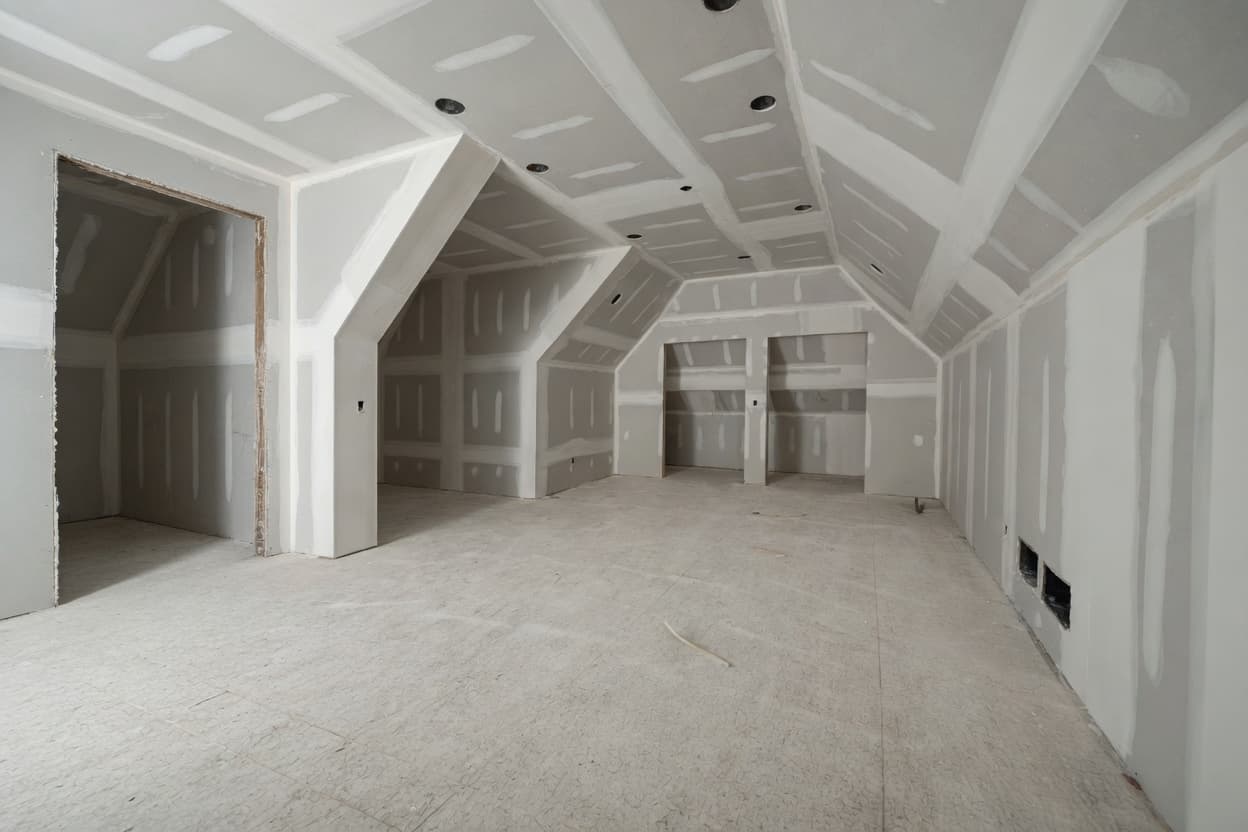
Every drywall estimate hinges on a number most homeowners have never heard of: the finish level. It's the single biggest lever on price, schedule, and how the wall will look after paint. Two levels cover almost every residential project — and picking the wrong one shows up on opening day.
The short answer
- Level 4 is the standard finish for most homes. It's what your house probably has today.
- Level 5 adds a thin skim coat over the entire surface. You need it under gloss paint or in rooms with raking light.
If your painter is using flat paint and the room doesn't catch harsh morning or evening sun on long walls, Level 4 is enough. If you're spec'ing semi-gloss, satin, or any sheen that will read under daylight, Level 5 protects the finish.
What the Gypsum Association actually says
The industry standard is GA-214, which defines six finish levels from 0 to 5. Level 4 is three coats of joint compound over tape, fasteners, and corners. Level 5 is everything in Level 4 plus a thin skim coat of compound or high-build primer applied across the entire surface, sanded smooth.
The practical difference is that Level 5 hides the substrate. Under Level 4, you can still see where the paper face of the board meets the joint compound — usually invisible under flat paint, but telegraphs through gloss or under strong light.
When we recommend Level 5
- Raking light exposure. Long walls that face windows with low-angle sun — think east or west-facing great rooms with glass above the fireplace.
- Semi-gloss or gloss paint. The finish amplifies any texture change in the substrate.
- Critical lighting design. Wall washers, recessed lights close to a wall, or track lighting angled down a surface.
- Commercial corridors with linear fixtures. Same raking-light problem at scale.
What Level 5 costs
As a rule of thumb, Level 5 adds 15–25% to the drywall portion of a project depending on ceiling height, access, and how much of the home you're upgrading. On a 5,000 sq ft custom home, that's a meaningful line item — but so is repainting a ceiling that telegraphs joints six months after move-in.
Bottom line
Specify Level 4 for most rooms. Specify Level 5 where you will see it — great rooms with raking light, ceilings under gloss, and anywhere you want the wall to read as a single plane. And put it on the drawings so everyone bids the same scope.