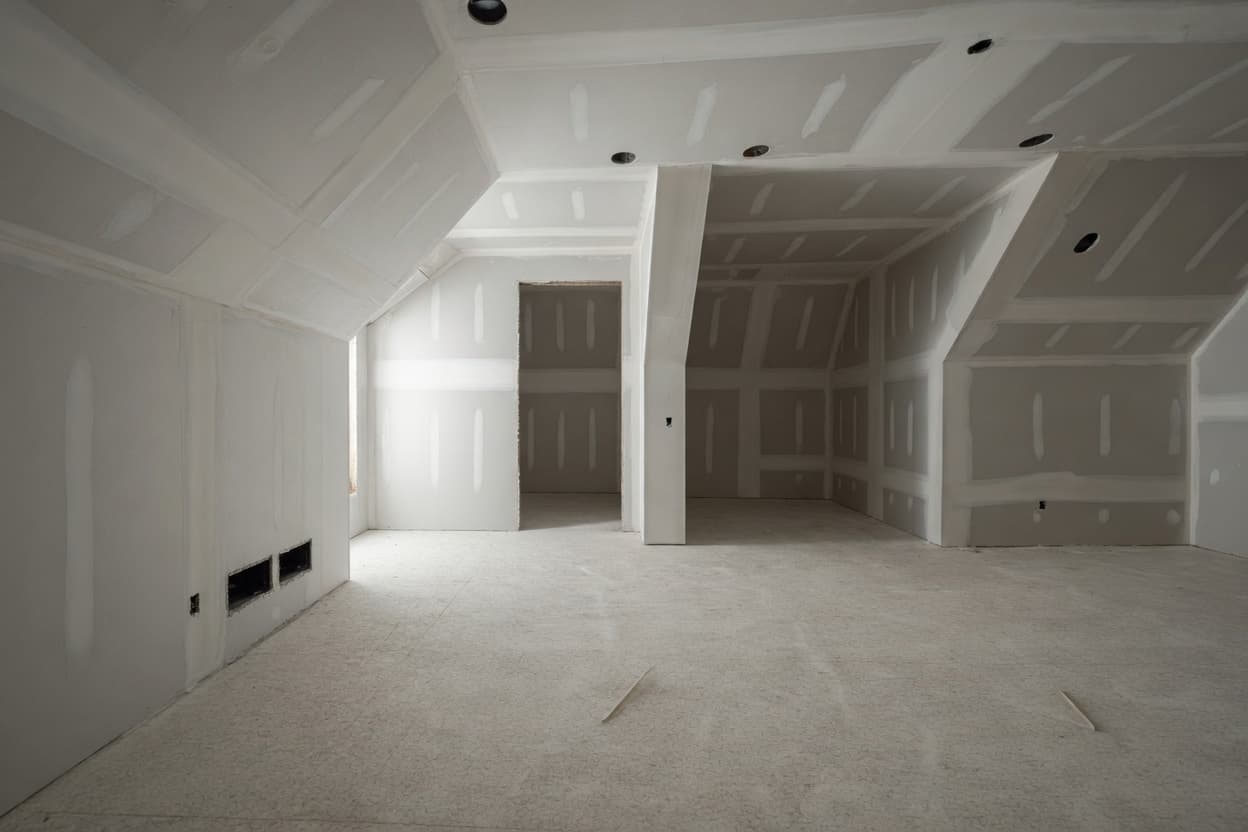
Finishing out an attic into a bonus room, office, or playroom is one of the most common remodels we bid in master-planned Houston neighborhoods. The framing and HVAC carry most of the cost, but the drywall scope is where three things quietly converge: the fire-separation code, the permit inspection, and whatever your HOA's architectural committee expects the finished space to look like. Get those wrong and the drywall comes back down.
Fire separation is the part people forget
If your attic shares a wall or floor-ceiling assembly with an attached garage, the drywall there isn't cosmetic — it's a rated fire barrier. In Houston that usually means 5/8" Type X on the garage side of common walls and on the ceiling if there's living space above. When you open an attic over a garage, you often discover the existing separation was built to the old standard or was never finished behind storage. The finish-out is the moment to bring it current.
- Garage-to-attic access (a pull-down ladder) penetrates the rated assembly. It needs a rated hatch or has to be relocated.
- Recessed lights and HVAC boots in a rated ceiling need fire-rated housings or boxes, not standard cans.
- The wall behind a new kneewall still has to maintain separation where it meets the garage.
We flag these at bid time, not at inspection, because retrofitting them after tape and texture is the expensive way to learn the rule.
Insulation and the vapor question
Houston attics are hot and humid, and a finished attic moves the insulation and air barrier with it. Before board goes up, confirm the insulation strategy — usually spray foam at the roof deck to bring the space inside the conditioned envelope. Hanging drywall over batts that were sized for an unconditioned attic traps moisture against the board and you get the tell-tale stains within a year. Drywall is the last thing in; it shouldn't be the thing hiding a bad envelope.
Kneewalls, slopes, and where the finish gets tricky
Attic rooms are full of the angles a flat-ceiling room doesn't have: sloped ceilings following the rafters, kneewalls at 3–4 feet, dormer returns, and the transition where slope meets flat. Those inside and outside corners are where finish quality shows. A few things we specify:
- Paper-faced metal bead on the long sloped outside corners — they take abuse and movement better than plastic on a span.
- Floating the slope-to-flat transition wide, because that's the joint most likely to telegraph a crack as the framing seasons.
- Level 4 minimum, Level 5 if the room gets the kind of low-angle window light an attic dormer throws across a ceiling — that raking light finds every imperfection.
What the HOA actually checks
Architectural committees rarely care about your tape joints. What they check is whether the finished space matches the approved plans and the neighborhood standard: no new exterior changes that weren't approved, dormers that match the elevation, and a finished result that reads as part of the house, not a converted attic. Where the drywall scope intersects the HOA is usually the dormer interiors and any new window returns — those need to be finished to the same standard as the rest of the house, because they're visible from the street through the glass.
How to scope it with us
When you ask us to bid an attic finish-out, the useful information is:
- The garage relationship — is there living space over the garage, and where's the attic access? That sets the fire-rated scope.
- The insulation plan — foam at the deck, or batts at the floor? We won't hang over the wrong envelope.
- Finish level and lighting — flat paint with texture, or smooth walls under dormer light?
- Permit status — finished attics are conditioned square footage and are permitted and inspected. We build the separation to pass, but the permit is part of the job, not an afterthought.
An attic finish-out is a great way to add real, comfortable square footage to a Houston home. The drywall is straightforward when the envelope and the separation are planned first — and a callback when they aren't.